Podcasts from the Mouse Biology Program
Dive into biomedical research, new papers, and even the inner workings of the Mouse Biology Program.
Each episode, edited by our staff and with help from Google Notebook LM, explores cutting-edge science with innovative mouse models to transform our understanding of human health and disease. Some of what our podcast covers:
- Research Breakthroughs: Discover the latest in genetics, phenotyping, and biomedical science.
- Review of Breaking Papers: Conversations about the latest in precision medicine, therapeutic innovations, and biomedical research.
- Program Insights: Learn how the Mouse Biology Program supports global research efforts.
Join us for in-depth discussions that connect mouse biology to the future of medical breakthroughs:
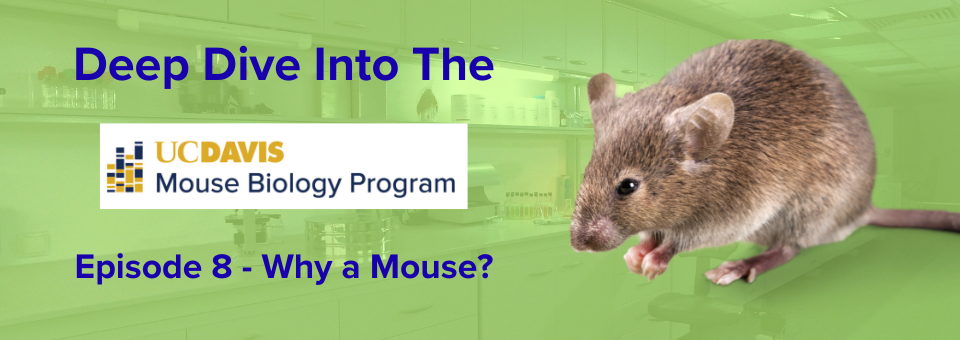
Audio Transcription
[00:00] Hello and welcome to Deep Dive, a platform generated with Google Notebook LM to discuss
[00:08] the world of mouse models and their importance in research, support and discovery. And now to Deep Dive.
[00:14] If a male scientist walks into a lab to test a new painkiller on a mouse, the drug might just
[00:22] completely fail. Right, but if a female scientist walks in to run that exact same test, it could
[00:27] actually pass. It’s just wild. Welcome to a custom Deep Dive today where we are taking you into the
[00:32] ultimate unsung hero of modern medicine. Yeah, we’re talking about the laboratory mouse because,
[00:37] you know, you might assume a lab mouse is just this generic blank slate. Right, just standard issue.
[00:42] Exactly. But functionally, they are these intricately calibrated biological instruments.
[00:47] Today we’re unpacking why these tiny animals are really the bedrock of human drug discovery.
[00:51] And how researchers actually design studies around them, plus why their genetics
[00:56] really only tell half the story. Yeah, the scale of their use is staggering. Mice make up roughly
[01:02] 95% of all research animals. Which is huge. And it’s not just because they’re small or,
[01:06] you know, cheap to feed. Functionally, a mouse’s lifespan acts like a biological time-lapse camera
[01:13] for human disease. That’s a great way to phrase it. Because one mouse year equals about 30 human years.
[01:20] Oh, wow. 30. Yeah, 30. Which is an incredibly powerful mechanism. Because their physiological
[01:27] systems mirror ours so closely, that accelerated timeline lets scientists observe an entire lifetime
[01:33] of disease progression. Or even chronic drug exposure. Right. In just two years. I mean,
[01:38] we wouldn’t have the breakthrough breast cancer drug Herceptin without that exact biological mirroring.
[01:44] Or, uh, the COVID-19 vaccines, honestly. Absolutely. Researchers actually used mice engineered
[01:50] specifically to express human ACE2 receptors. And that’s the cellular doorway the virus uses to
[01:56] infect us. Exactly. So that let them test vaccines on a perfectly matched infection pathway.
[02:01] But, you know, that accelerated biology is sort of a double-edged sword. If their metabolism is
[02:06] processing things that fast, their specific genetic makeup changes everything. It really does.
[02:11] The sources highlight this eye-opening study on acetaminophen, which is, uh, the active ingredient
[02:17] in Tylenol. Right. So they tested it across 16 different mouse strains, and almost all of them
[02:22] suffered liver damage. But the SJL strain survived completely unharmed. While the C57BL6 strain,
[02:29] which is basically your default, catalog standard lab mouse showed severe toxicity in just hours.
[02:36] Yeah. And it all comes down to the underlying metabolic pathways. Even though they are all mice,
[02:41] these highly inbred lineages, have entirely distinct liver enzymes.
[02:46] So the C57’s enzymes rapidly convert it into a toxic byproduct, while the SJL just metabolizes it
[02:52] differently. Right. Bypassing the toxic buildup entirely.
[02:54] Okay, wait. I have to stop you there, though. If the C57’s liver fails, but the SJL is perfectly fine,
[03:00] isn’t using mice just a biological coin toss?
[03:03] Well.
[03:03] I mean, if the data flips entirely based on the catalog number you order,
[03:06] how is this reliable for human medicine?
[03:09] And that is the exact trap so many people fall into, which is why meticulous study design is so
[03:14] critical. Right.
[03:15] Shockingly, the sources note that 70% of research failures stem from poor study planning,
[03:20] not bad lab execution.
[03:22] 70%. That’s massive.
[03:23] It is. You can’t just pick one strain and declare a drug safe for everyone. Researchers have to account
[03:27] for statistical power, use multiple specific genetic lines, and guard against phenotypic drift.
[03:33] Which is when a strain’s traits just subtly mutate over generations.
[03:37] Exactly. If you don’t calculate your sample size and strain selection perfectly,
[03:41] your data isn’t a breakthrough. It’s just statistical noise.
[03:45] And even if you nail the math and the genetics, there is this massive environmental wild card.
[03:50] Which brings us back to those male scientists ruining the painkiller data. I was totally floored by this.
[03:56] It’s the perfect example of unseen variables. Mice are incredibly sensitive to their environment.
[04:01] Right. So the pheromones secreted specifically by male handlers spike a mouse’s stress hormones.
[04:09] Yeah. And it completely masks their baseline pain-related behaviors.
[04:13] Which, if you think about it, makes evolutionary sense. If you are a tiny male mouse and you suddenly
[04:18] smell a giant unfamiliar male…
[04:20] Your brain thinks a massive predator just arrived.
[04:22] Right. Your cortisol spikes, adrenaline surges, and you are not going to show any signs of pain
[04:27] because you’re in pure survival mode.
[04:29] Exactly. The male pheromones trick the olfactory system.
[04:32] Uh.
[04:32] And stress alters everything.
[04:35] Just the simple act of handling a mouse can alter its muscle tone.
[04:38] Which completely skews the data if you’re trying to study a disease like, say, muscular dystrophy.
[04:44] Precisely.
[04:44] It’s like trying to accurately measure a car’s top speed, but you don’t realize the parking brake is on.
[04:49] You’re measuring the resistance, not the engine.
[04:51] That’s a really great analogy. It proves that genetics aren’t everything.
[04:56] Reproducibility relies on standardizing the diet, bedding, handling everything to minimize that stress.
[05:01] So clean environments lead to clean data.
[05:04] Exactly. Clean, life-saving data.
[05:06] So high-quality research isn’t just mixing chemicals in a tube.
[05:10] It’s this massive balancing act of precision genetics, environmental control, and flawless study design.
[05:18] Keep that in mind.
[05:19] Next time you take a perfectly safe, over-the-counter medicine for a headache,
[05:23] think about the generations of meticulously cared-for mice
[05:26] whose unique sensitivities made that safety guarantee possible.
[05:32] Thank you for listening to Deep Dive.
[05:34] For more information about the Mouse Biology Program, visit mousebiology.org.
[05:40] That’s one word, mousebiology.org.


Not seeing something you need? Contact Us